Apprenticeship Grants and Career Trajectories: A Structural Analysis
Canada faces persistent skilled labour shortages, yet only about 20% of apprenticeship registrants complete within the expected program duration. Apprenticeships are the primary pathway into the skilled trades, combining paid on-the-job training with technical instruction over a 3–4 year program. To encourage completion, the federal government introduced level-completion and one-time completion grants beginning in 2007. The existing grant structure was discontinued in March 2025, with proposals for a substantially more generous replacement currently under consideration, making counterfactual analysis of grant design particularly timely.
I build a dynamic discrete choice model of occupational choice and training investment estimated on linked administrative Canadian data from 2008 to 2020. I model individuals' career decisions as forward-looking choices that trade off short-run wage penalties during apprenticeship training against long-run completion premiums, with sector-specific human capital accumulating over time. The model allows prior work experience to affect program outcomes, reflecting the prevalence of delayed entry into Canadian apprenticeship programs. The estimated model is used to simulate counterfactual grant policies and their effects on enrolment, completion, and career trajectories.
The Early Career Returns to Apprenticeship Completion and Discontinuation
This paper estimates separately the early career returns to apprenticeship participation and completion in the skilled trades sector, using rich longitudinal data from British Columbia spanning 1992–2022. This includes records on the universe of high school graduates in 2008–2011, apprenticeship enrollees, university students, and their respective tax records. I estimate a treatment effects model that separately identifies the returns to program enrolment and completion. Using propensity score matching, individuals who choose apprenticeship paths are paired with similar individuals who chose different paths.
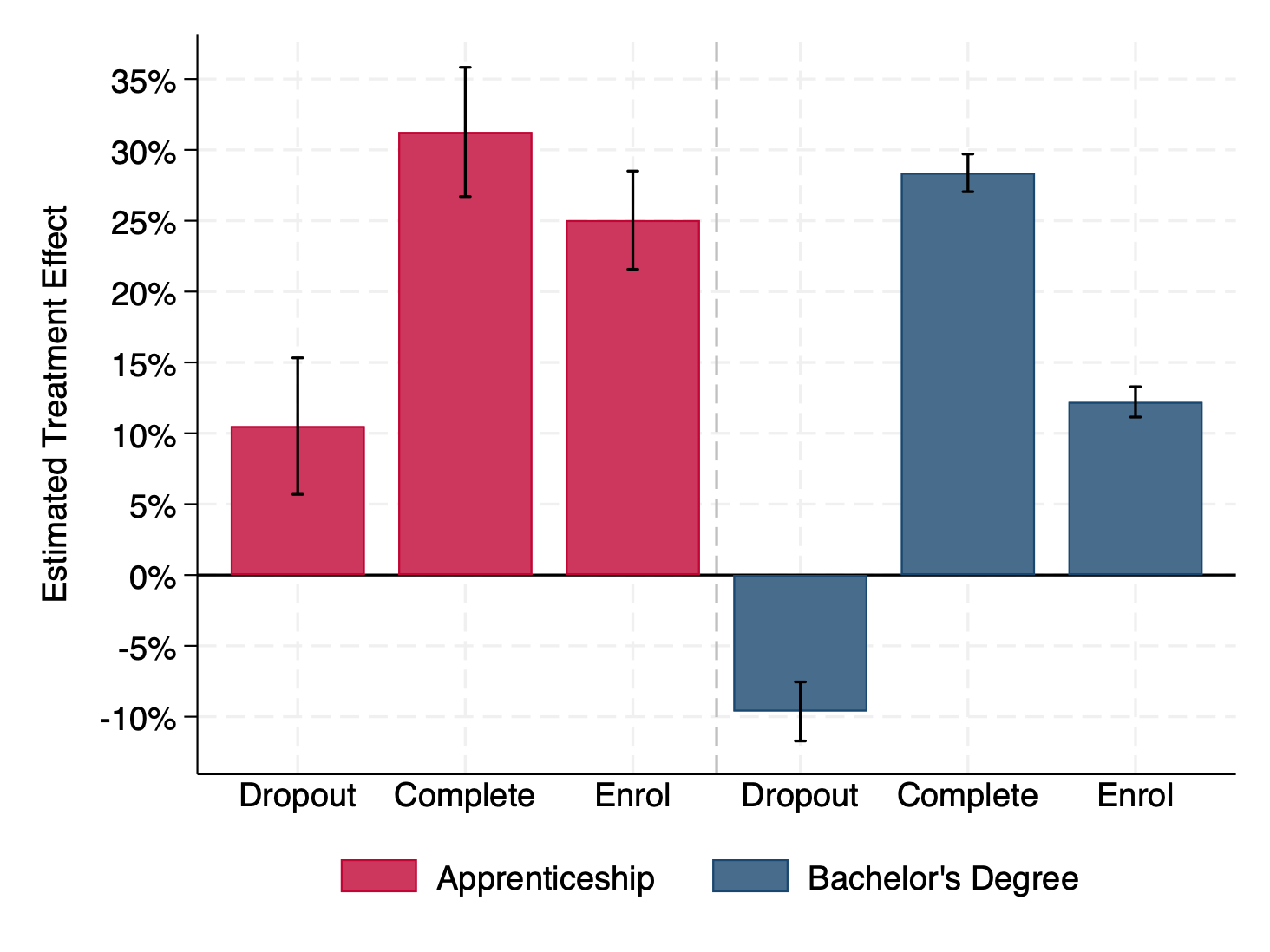
I find that the early-career return to apprenticeship enrolment is approximately 25% relative to never enrolling, compared to 12% for a four-year university degree. Apprenticeship dropouts earn more than non-enrollees, reflecting sorting into well-paying industries and firms rather than lost schooling investment. University dropouts, by contrast, earn less than non-enrollees, consistent with the opportunity cost of foregone work experience. These results highlight the importance of separately identifying returns at the enrolment and completion margins.
Figure: Decision tree for postsecondary pathways and earnings outcomes.
Figure: Average treatment effect on earnings at ages 27-31 of apprenticeship and university dropout, completion, and enrolment relative to matched high school graduates.
POLICY REPORTS
Lange, F., McLachlan, B. A., & Poschke, M. (2026). The Mismatch between Labour Supply and Demand in Quebec. CIRANO (2026RP-04). English version |
French version
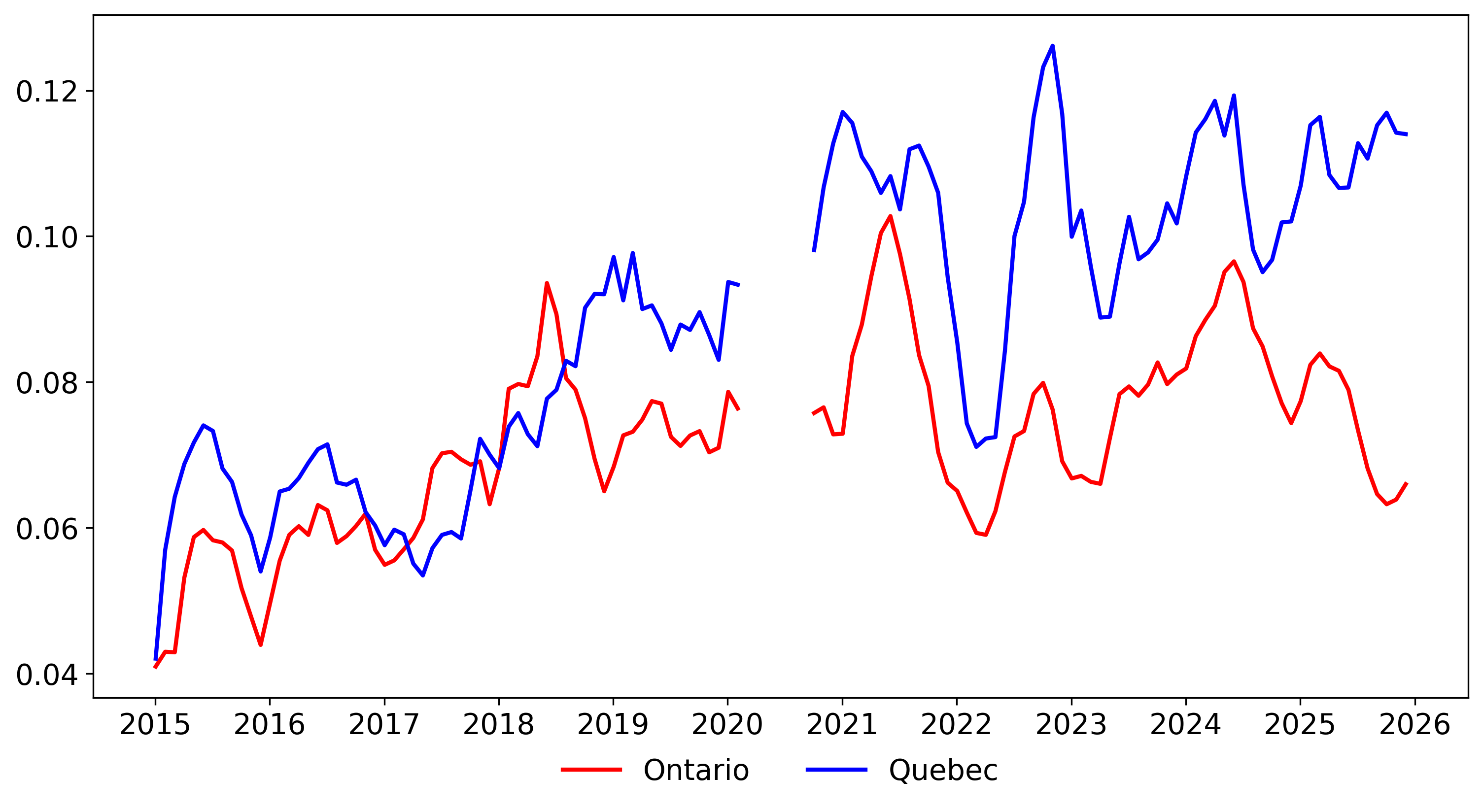
This report measures the extent to which job seekers and vacancies are concentrated in different industries in Quebec, and quantifies how this mismatch contributes to unemployment. Mismatch measures the proportion of hires lost due to individuals searching in sectors with low matching efficiency and/or many job seekers relative to available positions.
Figure: Mismatch Index for Quebec and Ontario (6-month moving average).
Figure: Industry contributions to aggregate mismatch in Quebec over time, select industries (6-month moving average).
AGRICULTURAL AND RESOURCE ECONOMICS
McLachlan, B. A. & van Kooten, G. C. (2022). Reforming Canada's Dairy Supply Management Scheme and the Consequences for International Trade. Canadian Journal of Agricultural Economics.
Link to paper. Preprint.
McLachlan, B. A., van Kooten, G. C., and Zheng, Z. (2020). Country-Level Climate-Crop Yield Relationships and the Impacts of Climate Change on Food Security. SN Applied Sciences. Link to paper
McLachlan, B. A., Afroz, S. and van Kooten, G. C. (2022) Effects of Temperature and Precipitation on Saskatchewan Crop Yields. Resource Economics & Policy Analysis Research Group. REPA Working Paper 2022-05
McLachlan, B. A. & van Kooten, G. C. (2022) CO2 Fertilization versus Temperature: A Meta-Regression Analysis of Crop Yields. Resource Economics & Policy Analysis Research Group. REPA Working Paper 2022-04